Introduction
Stepping off the plane at Kunming Changshui Airport from Chengdu, the first thing you notice is the air — thin, dry, and noticeably cleaner than the Sichuan basin you just left behind. At 1,890 meters above sea level, Kunming sits nearly 1,200 meters higher than Chengdu, and your lungs feel it immediately. That altitude difference only gets more dramatic as you travel deeper into Yunnan: Lijiang sits at 2,400 meters, and the Yuanyang rice terraces climb to around 1,800 meters on mountain slopes that drop into valleys below.
Yunnan is unlike anywhere else in China. Twenty-five of the country’s 56 recognized ethnic minorities live here. The province’s elevation ranges from just 76 meters at the Red River valley to 6,740 meters at Meili Snow Mountain’s peak. Kunming earns its nickname “Spring City” with highs of 20-25°C year-round, meaning you can visit any season without freezing or sweating through your clothes.
This guide covers a practical 7-day itinerary from Kunming through Dali and Lijiang to the Yuanyang rice terraces, with real prices, transport details, and the tips that most first-time visitors wish they knew beforehand.

How to Get There & Around
Flights
Kunming Changshui International Airport (KMG) is Yunnan’s main gateway. Direct flights run from Guangzhou (1,500 km), Chengdu (800 km), and Chongqing (700 km), typically costing ¥400-800 (€50-100) depending on the season and how far in advance you book. From Beijing or Shanghai, expect ¥600-1,200 (€75-150). Budget airlines like Spring Airlines and Lucky Air frequently offer promotions on these routes.
High-Speed Rail
The high-speed rail network is the most practical way to travel between Yunnan’s main destinations:
- Kunming → Dali: 2 hours, ¥145 (~€18). Trains depart every 30-60 minutes from Kunming South Station.
- Dali → Lijiang: 1.5 hours, ¥80 (~€10). Convenient and frequent.
- Kunming → Lijiang: 3.5 hours direct, ¥220 (~€28). Alternatively, break the trip in Dali.
If you haven’t used China’s high-speed rail system before, read our China High-Speed Train Survival Guide for booking tips, seat classes, and what to expect.
Local Transport
- Dali: Rent an electric scooter for ¥50/day (~€6) — the best way to explore Erhai Lake’s 130-kilometer coastal road. Gas scooters are also available for ¥80-100/day but require a Chinese license.
- Lijiang: Metered taxis start at ¥7 for the first 3 km. Most drivers use the meter without being asked, unlike in some Chinese cities.
- Yuanyang: No high-speed rail reaches Yuanyang directly. From Kunming, take a bus to Mengzi (4-5 hours, ¥120-150) then transfer to a minivan to Yuanyang’s Xinjie town (1.5 hours, ¥30). A shared car from Kunming costs ¥150-200 per person and takes 6-7 hours total.
7-Day Itinerary: Kunming → Dali → Lijiang → Yuanyang
Day 1: Arrive in Kunming
Land at Kunming Changshui Airport. Take the Airport Express Line 6 to the city center (¥13, ~25 minutes) or a taxi for about ¥80. Check into your hotel near Green Lake Park (Cuihu Gongyuan) — this area puts you within walking distance of restaurants and the old city center.
Afternoon: Walk around Green Lake Park (free entry). If you visit between November and March, thousands of Siberian seagulls migrate here, and locals sell bird food for ¥5 a bag. The park is also surrounded by antique shops and tea houses.
Evening: Head to Nanping Street for dinner. This pedestrian area is Kunming’s food hub, packed with restaurants serving cross-bridge rice noodles, grilled mushrooms, and Yunnan-style BBQ. Budget around ¥30-50 (~€4-6) for a solid meal.
Sleep: Kunming. Budget hotels near Green Lake start at ¥100-150/night (€13-19). Mid-range options (Citadines, Atour) run ¥200-350 (€25-44).
Day 2: Kunming → Dali
Morning: Take the high-speed train from Kunming South Station to Dali (2 hours, ¥145). Book your ticket via the 12306 app or Trip.com — available in English.
Afternoon: Walk through Dali Ancient Town’s main streets. The town is free to enter (the old “maintenance fee” was abolished in 2026). Key stops: the South Gate, Fuheng Road for souvenir shops, and Renmin Road for cafes and bars.
Rent an electric scooter and ride along Erhai Lake’s western shore (about 2 hours round trip). Stop at Caicun Pier for photos of the lake with Cangshan Mountain in the background.
Evening: Eat at one of the restaurants along the ancient town’s west gate. Try the local Bai-style grilled fish (¥30-50 per dish).
Sleep: Dali Ancient Town. Guesthouses here cost ¥80-200/night (~€10-25).
Day 3: Dali — Three Pagodas, Xizhou & Cangshan
Morning: Visit the Three Pagodas of Chongsheng Temple (Chongsheng Si). Tickets are ¥75 (~€9), and the site opens at 8:00 AM. Arrive early to photograph the 1,000-year-old pagodas reflected in the front pool before the crowds arrive.
Midday: Take a local bus (¥8, 40 minutes) or drive to Xizhou Ancient Town, 18 km north of Dali. This Bai minority town is free to enter and far less commercialized than Dali’s main ancient town. The Bai architecture — white walls with grey tile roofs and painted murals — is well-preserved. Try the local Xizhou baba (a stuffed flatbread) for ¥5-10.
Afternoon: Take the Cangshan cable car (Zhonghe cable car, ¥35/~€4) up Cangshan Mountain. The ride takes about 15 minutes and drops you at around 2,800 meters. Walk the Jade Cloud Road (Yuyun Road), a 7-kilometer paved trail along the mountain ridge with panoramic views of Erhai Lake below.
Sleep: Dali.
Day 4: Dali → Lijiang
Morning: High-speed train from Dali to Lijiang (1.5 hours, ¥80). Lijiang Station is about 10 km from the old town — take bus #18 (¥2) or a taxi (¥30-40).
Afternoon: Explore Lijiang Ancient Town (free entry, no maintenance fee since 2026). The UNESCO World Heritage site is a maze of cobblestone streets, canals, and traditional Naxi wooden houses. Key spots: Mufu Palace (Mu Fu, ¥40/~€5) — the former residence of the Naxi royal family, rebuilt in the 1990s. Square Street (Sifang Jie) is the center of the old town and a good starting point.
Evening: Lijiang’s bar street near the old town center is lively but overpriced. For a more authentic experience, walk to the north side of the old town where locals eat. Try the Naxi grilled potatoes with spicy dip (¥5-10).
Sleep: Lijiang. Accommodation ranges from ¥80-150 for guesthouses on the old town’s edge to ¥300-600 for boutique hotels inside the town.
Day 5: Jade Dragon Snow Mountain — Full Day Trip
Jade Dragon Snow Mountain (Yulong Xueshan) dominates Lijiang’s skyline at 5,596 meters. Book your tickets in advance via the official “Yulong Xueshan” WeChat mini-program. The combination ticket (mountain entry + large cable car to Glacier Park at 4,506 meters) costs ¥180 (~€23). Oxygen canisters are sold at the base for ¥20-30 — buy one if you’re not used to altitude.
The large cable car takes you to 4,506 meters. From there, a wooden boardwalk climbs to 4,680 meters. Take it slow — the altitude hits hard. Most visitors spend 1-2 hours at the top before descending.
Afternoon: Visit Blue Moon Valley (Lanyue Gu), located at the mountain’s base. The turquoise pools are caused by dissolved minerals from the glacial runoff. Entry is included in the mountain ticket. Shuttle buses run between the valley and the cable car station.
On your way back, stop at Shuhe Ancient Town (free), 6 km from Lijiang. Smaller and quieter than Lijiang’s main old town, it’s a pleasant place to walk and grab dinner.
Sleep: Lijiang.
Day 6: Lijiang → Yuanyang
This is the longest travel day of the trip. No direct high-speed rail reaches Yuanyang. Your options:
- Shared car/minivan: ¥150-200 (~€19-25) per person, arranged through your hotel or on travel apps like Fliggy. Takes 6-7 hours with a rest stop.
- Bus route: Lijiang → Kunming (3.5h by train) → Mengzi (bus, 4-5h) → Yuanyang Xinjie (minivan, 1.5h). This takes a full day and is only worth it if you want to stop in Kunming.
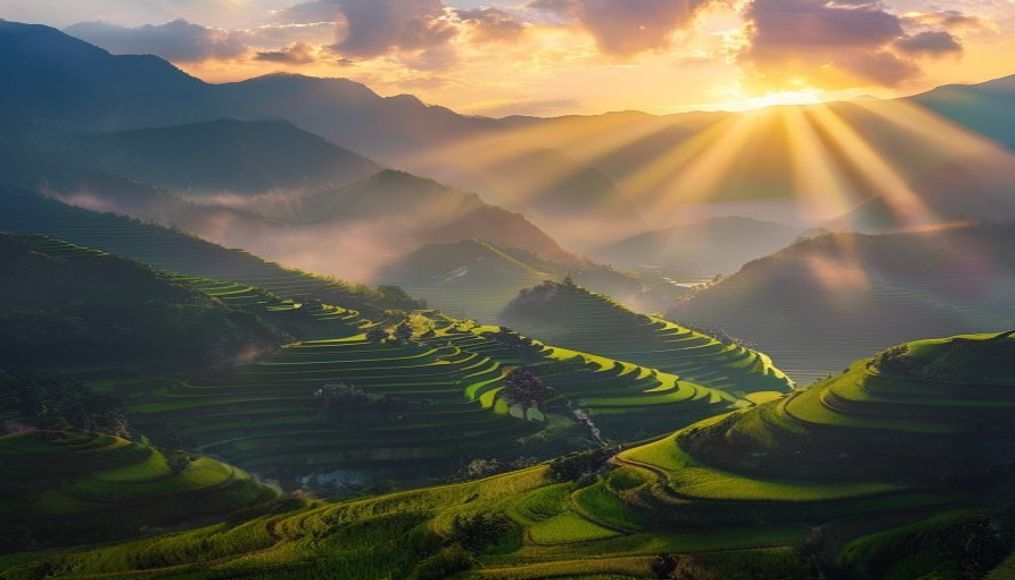
Arrive in Xinjie town (Yuanyang’s main accommodation hub) in the late afternoon. Head straight to Bada Viewing Platform (坝达观景台) for sunset. The terraces here face west and catch the last light of the day, turning the flooded paddies gold and orange. The view spans hundreds of layers of terraces carved into the valley.
Sleep: Xinjie town. Guesthouses cost ¥80-200/night (~€10-25). Book in advance during peak season (December-March).
Day 7: Yuanyang Sunrise → Return
Wake up early for the Duoyishu (多依树) viewing platform sunrise. This is the main attraction in Yuanyang — the terraces face east and the rising sun reflects off the water-filled paddies, creating a layered mirror effect. You need to arrive by 6:30 AM in winter to secure a good viewing spot. Bring warm clothes; temperatures at dawn can drop to 5°C even in spring.
After the sunrise (around 7:30 AM), drive or take a local minivan (¥15) to Qingkou (箐口) viewing platform, which is walkable from Xinjie town. Qingkou is surrounded by a traditional Hani village, and the terraces here are set against dense forest. Entry is included in the main Yuanyang ticket.
The Yuanyang Rice Terraces ticket costs ¥100 (~€13) and covers all three main viewing platforms (Duoyishu, Bada, Qingkou) for one day. Buy it at the main entrance gate on the road from Mengzi.
Afternoon: Begin your return journey to Kunming (6-7 hours by shared car). If you’re flying out the next morning, consider spending one more night in Kunming near the airport.

Best Time to Visit Yunnan
| Month | Rating | Why |
|---|---|---|
| March - May | ★★★★★ | Spring warmth, flowers blooming, Yuanyang terraces still filled with water (April is peak) |
| September - November | ★★★★ | Clear skies, comfortable temperatures, autumn harvest season |
| June - August | ★★★ | Rainy season — fewer tourists, cooler weather, but overcast days and landslides possible on mountain roads |
| December - February | ★★★ | Lijiang gets cold (0-10°C), but Jade Dragon Snow Mountain is at its most dramatic and Yuanyang’s flooded terraces are in peak condition |
The Yuanyang rice terraces have their own micro-season: the paddies are flooded from November to April (irrigation and early growth), creating the mirror-like reflections that photographers chase. From May to October, the terraces turn green, then gold during harvest. If photography is your priority, go between December and March.
What to Eat: Real Prices
Yunnan’s food is distinctive — it uses fresh herbs, flowers, mushrooms, and chili in ways you won’t find elsewhere in China. Here’s what to try and what it costs:
- Cross-bridge rice noodles (Guoqiao Mixian) — Kunming’s signature dish: a bowl of hot broth arrives with raw ingredients on the side (chicken, pork, quail egg, vegetables) that you cook by sliding them into the boiling soup. ¥15-30 (
€2-4) at local restaurants, ¥50-80 (€6-10) at tourist-oriented spots. - Flower pastry (Xianhua Bing) — Rose-petal filled shortbread, a popular Kunming souvenir. ¥5-10 per piece (~€0.60-1.25). Buy them at Juhua Xincun bakery — the original and best.
- Dali earthen pot fish (Shaguo Yu) — Fresh fish from Erhai Lake cooked with local ham, tofu, and mushrooms in a clay pot. ¥50-80 (~€6-10) per pot, enough for two people.
- Lijiang cured rib hotpot (Lapaigu Huoguo) — Salted ribs slow-cooked in a split pot. ¥60-100 (~€7.50-12.50) per person.
- Iron plate tofu (Tieban Doufu) — Served at every night market in Yunnan, crispy on the outside, soft inside, topped with chili and cilantro. ¥5-10 (~€0.60-1.25).
Actionable tip: Skip the tourist restaurants in Dali and Lijiang old towns and head to Kunming’s Zhuanxin Farmers’ Market (篆新农贸市场). It’s a real working market where locals buy fresh produce, mushrooms, and prepared food. A full meal here costs ¥15-25 (~€2-3). Try the smoked tofu rolls, steamed chicken with local herbs, and fresh flower juices.
For a deeper dive into Chinese street food culture, see our Chinese Street Food: A First-Timer’s Guide to Night Markets and Street Stalls.
Yuanyang Rice Terraces: A Detailed Guide
The Yuanyang rice terraces were carved into the Ailao Mountains by the Hani people over 1,300 years ago. Today they cover about 17,000 hectares and are a UNESCO World Heritage Site. Here’s what you need to know to make the most of a visit:
Three Main Viewing Platforms:
- Duoyishu (多依树) — The sunrise platform. Terraces face east at around 1,800 meters altitude. The sun rises behind the mountains and illuminates the flooded paddies layer by layer. Arrive by 6:30 AM (even earlier in peak season) to get a spot on the main viewing deck.
- Bada (坝达) — The sunset platform. Faces west, offering the widest panorama of the terraced valley. Best visited between 5:00-6:30 PM depending on the season.
- Qingkou (箐口) — An all-day platform within walking distance of Xinjie town. Less dramatic than the other two, but the surrounding Hani village and forest setting make it the most culturally immersive.
Practical Details:
- Ticket: ¥100 (~€13), valid for one day, covers all three main viewing platforms.
- Best season: November through April (flooded paddies = mirror reflections). December to February is peak photography season.
- Accommodation: Xinjie town has guesthouses from ¥80-200/night (~€10-25). The closest options to Duoyishu are pricier (¥150-300) but save you the early morning drive.
- Getting around: Hire a local driver for ¥200-300/day (~€25-38) to visit all three platforms. Shared minivans from Xinjie to individual platforms cost ¥15-30 per ride.
Ethnic Minorities: What You Can Actually Experience
Yunnan’s ethnic diversity isn’t a museum exhibit — it’s lived culture that you can see, taste, and participate in. Here are the three groups you’re most likely to encounter on this route:
Bai (白族) — Dali region: The Bai are the largest ethnic group in the Dali area. The most accessible cultural experience is the Three-Course Tea ceremony (三道茶), where a Bai host serves three rounds of tea representing life’s stages: bitter (raw tea), sweet (with walnut and sugar), and aftertaste (with honey and cassia). The ceremony costs ¥30-50 (~€4-6) and is offered at several tea houses in Xizhou Ancient Town.
Actionable tip: Visit Zhoucheng village (周城), 23 km north of Dali, to try tie-dye (扎染) at a traditional workshop. You pick the pattern, the artisan folds and ties the fabric, and you dip it into indigo vats yourself. A DIY piece costs ¥50-100 (~€6-13) and takes about 1-2 hours. This is a genuinely hands-on experience, not a tourist show.
Naxi (纳西族) — Lijiang region:
The Naxi people are known for their Dongba script, one of the world’s few still-used pictographic writing systems. The Dongba Culture Museum near Lijiang old town (¥30/€4) displays manuscripts, ritual objects, and explanations of the Dongba religion. Naxi ancient music performances run nightly at several venues in the old town (¥80-150/€10-19) — the most authentic are organized by the Dayan Naxi Ancient Music Association.
Hani (哈尼族) & Yi (彝族) — Yuanyang region: The Hani built the Yuanyang terraces and still farm them today. You’ll see Hani women in traditional indigo clothing working the fields, especially at Qingkou village. The Yi people inhabit the higher mountain areas around Yuanyang and are known for their embroidered garments and torch festivals. The fire pit (火塘) remains central to both groups’ homes — if you’re invited into someone’s house, you’ll sit around it for tea and conversation.
Budget Estimate for 7 Days (Per Person)
| Item | Cost (RMB) | Cost (EUR) |
|---|---|---|
| Round-trip flights or high-speed rail to Kunming | ¥800-1,600 | ~€100-200 |
| Accommodation (6 nights, budget-mid range) | ¥500-1,200 | ~€63-150 |
| Food (7 days) | ¥400-700 | ~€50-88 |
| Attraction tickets (Three Pagodas, Mufu, Jade Dragon, Yuanyang, etc.) | ¥300-500 | ~€38-63 |
| Local transport (scooters, taxis, shared cars) | ¥400-600 | ~€50-75 |
| Total | ¥2,400-4,600 | ~€300-575 |
This budget assumes you’re traveling as a couple or small group (sharing room and transport costs). Solo travelers should add 20-30% to accommodation and transport. Luxury travelers can expect to spend ¥6,000-10,000+ (~€750-1,250+) for the same itinerary with boutique hotels and private drivers.
For more on eating well in China without overspending, read our Gastronomic Adventure in China: A Foodie’s Guide for European Travelers.
Things Nobody Tells You
The “ancient town maintenance fee” is gone. Both Dali and Lijiang old towns used to charge a daily maintenance fee (¥30-80) to visitors. As of 2026, this fee has been abolished at both locations. Don’t let anyone tell you otherwise — some taxi drivers and “tour guides” near the entrances still try to sell “entry tickets.”
Lijiang’s “Tea Horse Road” horse riding is mostly a tourist trap. The horse riding experiences advertised along Lijiang’s main roads charge ¥150-300 for a 30-minute ride on a paved path. The real Tea Horse Road (茶马古道) hiking route runs through Shaxi Ancient Town (沙溪古镇), 120 km from Lijiang. If you want an authentic experience, take a bus to Shaxi instead — the old caravan staging post has genuine Qing Dynasty architecture and no admission fee.
Jade Dragon Snow Mountain tickets require advance booking. The mountain’s visitor capacity is capped daily. Buy your ticket at least 1-2 days ahead via the official WeChat mini-program (“玉龙雪山”). If you show up on the day without a reservation, you may be turned away — especially during Chinese holidays.
Getting to Yuanyang takes effort. There is no direct high-speed rail to Yuanyang. The most efficient route from Kunming is Kunming → Mengzi (high-speed rail, 2.5 hours, ¥74) → Xinjie town (minivan, 1.5-2 hours, ¥30-40). Total travel time is about 5-6 hours. Budget the entire day for this transfer.
SPF 50+ is not optional. Yunnan’s UV index regularly hits 11-12 (extreme) at these altitudes. Sunburn at 2,400 meters in Lijiang happens fast, even on overcast days. Bring SPF 50+ sunscreen and reapply every 2 hours. A hat and sunglasses are equally essential.
Related Guides
If you’re planning a broader China trip, these guides pair well with Yunnan:
- Xi’an Terracotta Army: History, Discovery, and Insider Tips — Xi’an is a natural starting or ending point for a Yunnan trip, with direct flights from Kunming.
- Zhangjiajie Avatar Mountains: Complete Guide — Combine Yunnan’s cultural landscapes with Zhangjiajie’s dramatic sandstone pillars for a varied itinerary.
- Guilin and Yangshuo: The Ultimate Karst Landscape Guide — Guilin offers a completely different kind of mountain scenery in southern China.
- China High-Speed Train Survival Guide — Essential reading for navigating China’s rail booking system.